Idolizing Shame
On the doors we keep closed and the stories they hold

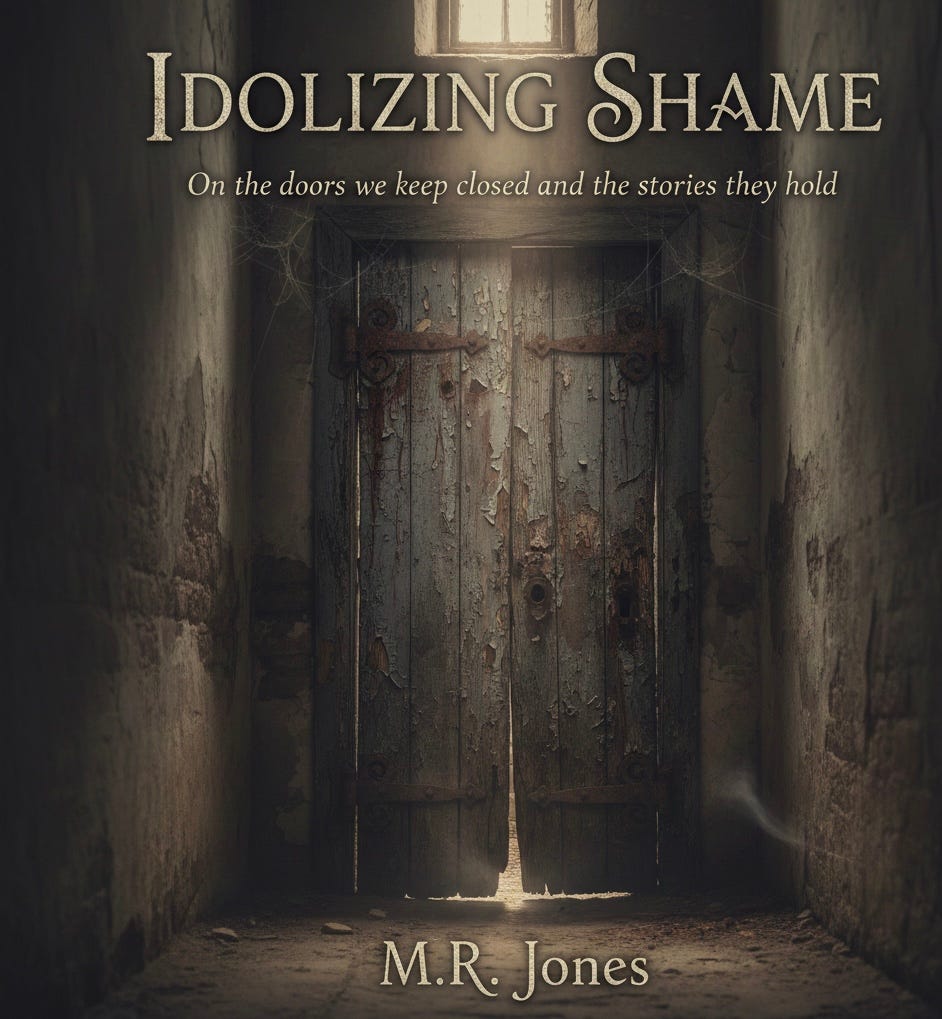
INTRO:
Some doors in us don’t slam shut — they just drift closed over time. We don’t even notice the moment it happens. Silence settles into the hinges, memory thickens around the frame, and before we know it, a whole part of ourselves becomes a room we walk past without entering.
Lately I’ve been paying attention to those internal doors — the ones swollen with old feelings, quiet fears, and stories I learned to keep to myself. I wrote this piece while thinking about how shame ages: how it stains, how it creaks, how it imitates both decay and creation.
This poem came from listening to that silence.
⸻
Locked shut so long,
no idea when it last swung open
When the hinges were new—unstained,
free of rust and regret,

panels not yet tinged gray
with sadness and small cracks
showing its age
absent the groans and creaks

merging decay and creation,

sounding like an old tomb—or maybe a pregnant womb.

Now it is a door swollen with silence,
paint peeling like old scabs,
whispering secrets between drafts
about the things I hid without a trace.

Behind it lies a room
my memory keeps repainting—
a single chair, a breath of dust,
and disappointment seeping through the cracks—

invisible, intangible,

pervasive, deadly.


Who knew emotion could wield tools so corrosive?
Stripping the door of paint and strength
Pain leading to disrepair—gouges left open and bare
Who knew shame could be so deceptive?
Blurring the lines between fact and invention.

I stretch out my hand towards the door
just shy of grabbing the knob
But I don’t have the key—
my fingers tremble
and fall back to my side.

I absently trace the scars in the wood,
avoiding the many splinters ,
too tired to sand them.

And that is why the door is here at all,
standing as both an unhealed scar,
and a silent guard.

Both a monument and a sentinel.

Is it mocking or honoring?
Protecting or imprisoning me?

It makes me wonder.

This thing I have locked up,
this suffering I thought I was suppressing.

Have I actually built an idol of my suffering?

Allowing my demons—
the guilt, despair, and fear—
to take up residence?
Instead of confronting them face to face
I’ve carved out for them a comforting space inside me, a welcoming place.

So who is really imprisoned?

Them—or me?

Or have we become one and the same,

bound, challenged, changed

by the same silent refrain:

Shame.

Still shame.

I whisper to myself,

“When will enough be enough?”

I cannot serve this idol anymore.
I won’t sacrifice on this altar any longer.

I lean against the wood
but it’s so rotted and weak,
it gives way on its own,
never as solid as I believed.


M.R. Jones
⸻
REFLECTION:
Writing this made me realize how often we mistake being closed-off for being safe. Shame can feel protective at first, like a lock we choose. But over time it becomes a structure that keeps us from our own air. I’ve learned that opening isn’t a single moment; it’s a slow negotiation with the parts of myself I’ve ignored.
I’m still learning that a door can be old, weathered, even rusted — and still open.
If this poem touches something in you, I hope it reminds you that nothing inside you is beyond repair. Some doors creak not because they’re breaking, but because they’re finally moving.
This is shame getting caught in a mirror and realizing it’s been cosplaying as protection. I love how the door starts out all solemn and sacred and then slowly gets exposed as an altar you never meant to build but somehow kept lighting candles at. Tomb and womb? Rude. Brilliant.
That moment where the door gives way on its own is such a quiet mic drop — all that fear, all that guarding, and it was never as solid as advertised. And the line about refusing to serve the idol anymore? That’s soft rebellion, inside voice, spine fully engaged. The creak isn’t collapse — it’s movement. Honestly powerful in the most unflashy way.
Facing what makes us feel ashamed can be a liberating experience. Thank you for this poem.