The Borrowed Clearing
There is a silence thinking cannot keep

Sometimes the mind loosens its grip for a moment—
not silence exactly, but a small clearing between thoughts.
This poem came from noticing that space.
Between two thoughts
there is a narrow clearing—
a place the mind can’t claim,
some call it
the place where the “I” loosens,
maybe a bit too on the nose,
but my spirit seems to agree:

It’s empty of noise here,
but not lonely.

The shape of solitude isn’t soft,
but the edges aren’t hard enough to define.

No argument lives there,
only the echo of memory
pressing its fingerprints
into the soft clay of attention.

And sometimes,
in that borrowed clearing,
where ownership doesn’t exist
and you can’t call it a gift,

something older than thought waits

for me to
stop speaking,
stop asking.


When I listen,
for a moment
the static finally settles—

where thinking
used to be in control,

only feeling
passes through.


M.R. Jones
REFLECTION:
There are moments in a day that feel almost accidental—brief pauses where the mind loosens its grip on itself. They usually pass unnoticed. A thought finishes, the next one hasn’t arrived yet, and for a second the constant narrator in our heads goes quiet.
Most of us live inside our thoughts so completely that we assume they are the only way to experience the world. The mind names things, organizes them, argues with them, remembers them, prepares for them. It builds the sense of a stable “I” moving through time. In many ways that ability is necessary. Without it, life would feel chaotic and directionless.
But occasionally something else happens.
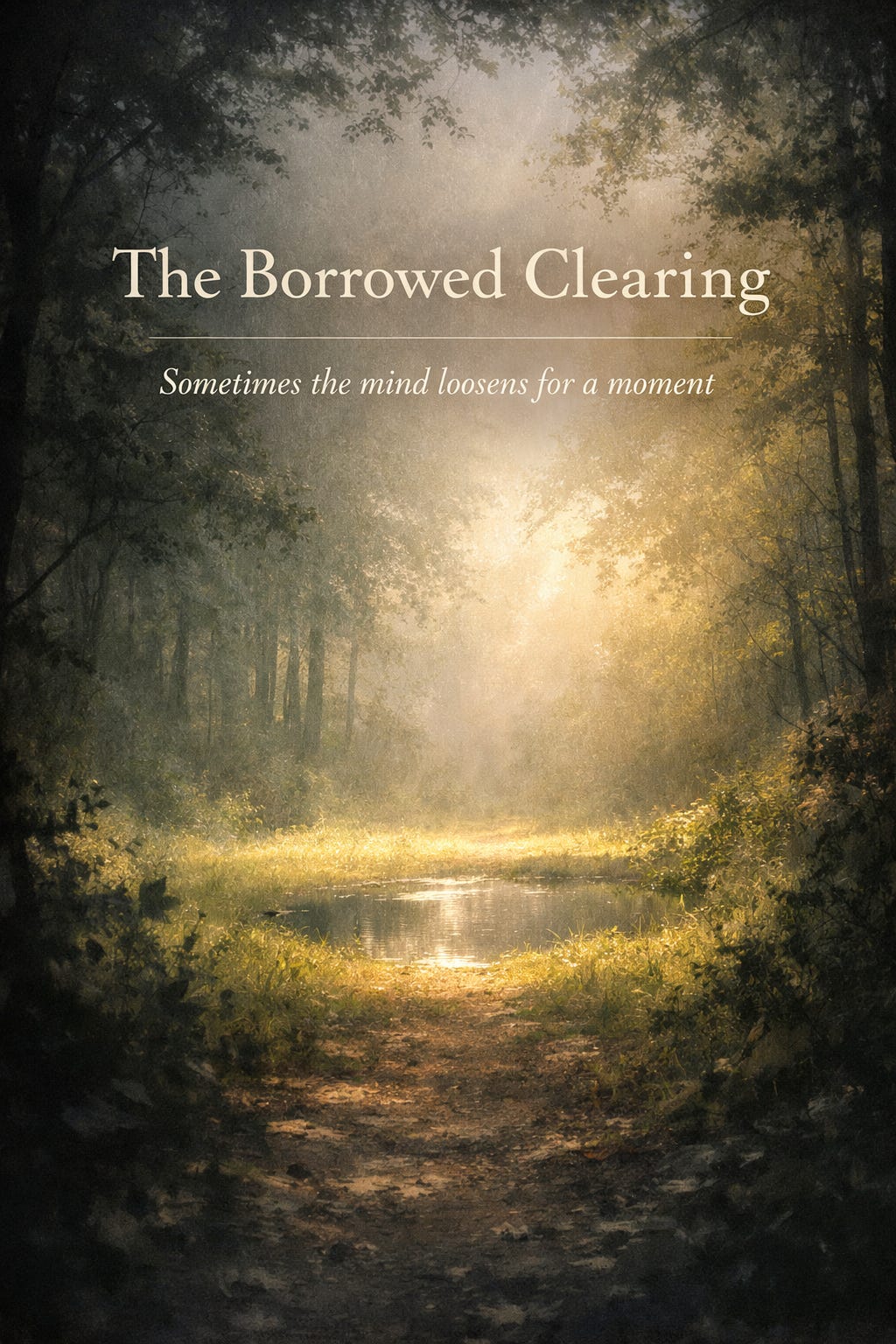
There is a small opening between thoughts—so brief that it almost disappears the moment we notice it. It doesn’t feel like silence exactly. It feels more like a clearing in a dense forest: not created intentionally, not owned by anyone, just suddenly there.
In that space the mind isn’t trying to interpret or control anything. Memory might still echo faintly, and attention drifts the way light moves across an open field, but the usual urgency of thinking relaxes. For a moment, the self stops insisting on being the center of everything.
Many contemplative traditions have tried to describe this kind of experience. Practices like Christian Contemplative Prayer or Zen Buddhism often speak about quieting the mind in order to encounter something deeper than ordinary thought. But the interesting thing is that we don’t necessarily need a formal practice to stumble into that moment. Sometimes it simply appears on its own—while walking, sitting in silence, or noticing the world without trying to explain it.
The poem came from paying attention to that fleeting clearing.
What interests me about those moments isn’t just the silence itself, but the subtle shift that happens when thinking stops trying to lead. Something else seems to move through awareness instead—something quieter and older than the constant narrative of the mind.
Not a voice exactly. Not a conclusion.
Just a brief sense that there is more to experience than the thoughts we spend most of our lives believing.
For a moment, the static settles. And what remains isn’t control, but feeling passing through.
Ah! That gentle but, oh so brief of clarity. Nicely said.
«Это не совсем тишина. Скорее, похоже на поляну в густом лесу: не созданную намеренно, никому не принадлежащую» — вот эта формулировка. Именно она. Не «молчание» и не «пустота» — а место, у которого нет хозяина.
Ты нашёл слово для чего-то, что обычно ускользает, потому что его некуда положить. Большинство пишет об этом как о практике или достижении — у тебя это случается само, и именно поэтому не присваивается.
Интересно, что ты не стал объяснять, что делать с этой поляной — только описал, как она выглядит изнутри. Может быть, потому что любое «делать» её сразу закрывает.
Вопрос: а бывает ли этот момент страшным — когда «я» перестаёт настаивать на себе?
@lintara